By Manoj Meek
As December 3rd approaches, a familiar heaviness descends upon the air in Bhopal. The phantom wail of sirens, the memory of that chaotic night, and the endless silence that followed—we all remember. Many of us have lived through that era and the series of tragedies that ensued. But today, as a columnist and a responsible citizen of this city, I choose to look beyond the chemical haze.
We dream of building a ‘Kamaal Ka Bhopal’ (Phenomenal Bhopal), but to do so, we must confront a bitter economic truth that has remained hidden behind shock and emotion for the last four decades. The truth is: Bhopal didn’t just lose its people; it lost its Time and its Resources.
Visible Ruin vs. The Invisible Tragedy: A Global Paradox

A study of global industrial and war-time disasters reveals a cruel paradox. When we look at Hiroshima and Nagasaki (1945) or Fukushima (2011), the destruction was ‘visible.’ Cities reduced to rubble were seen by the world, prompting immediate national missions for reconstruction. Following the Fukushima disaster, the Japanese government committed nearly $187 billion for reconstruction and cleanup.
Bhopal’s ‘Chemical Tragedy’ was different. Here, the poison was in the air—invisible. Buildings didn’t fall, factories remained standing, but human generations collapsed. Because this damage was ‘invisible’, Delhi and the world assumed the city was still standing.
The result? Unlike Fukushima or Hiroshima, which received ‘Reconstruction,’ Bhopal received only a long ‘legal battle’ and an inadequate settlement of $470 million in 1989. This was the historic blunder that pushed Bhopal’s economy into a coma.
The Lost Decade and the Economic Blockade
Let us look at this through the mirror of data. In 1984, Bhopal was an emerging industrial hub. Then came the 1990s—the whirlwind of economic liberalization and the IT revolution in India. Cities like Bengaluru and Hyderabad seized this opportunity. Today, Bengaluru boasts a GDP of approx $110 billion and Hyderabad sits at $75 billion.
But Bhopal? Bhopal was counting its last breaths. While other cities were writing ‘software code,’ Bhopal was reading ‘medical reports.’ A study published in BMJ Open (2023) screams the truth: the second generation of gas victims faces higher rates of employment disability. This was not just a health crisis; it was an undeclared ‘economic blockade’ that fractured our human capital.
From Cave to Code: The Renaissance
Yet, there is a stubborn resilience in Bhopal’s soil. The spark buried beneath the ash has not been extinguished. Four decades later, Bhopal looks the world in the eye and says—we are ready.
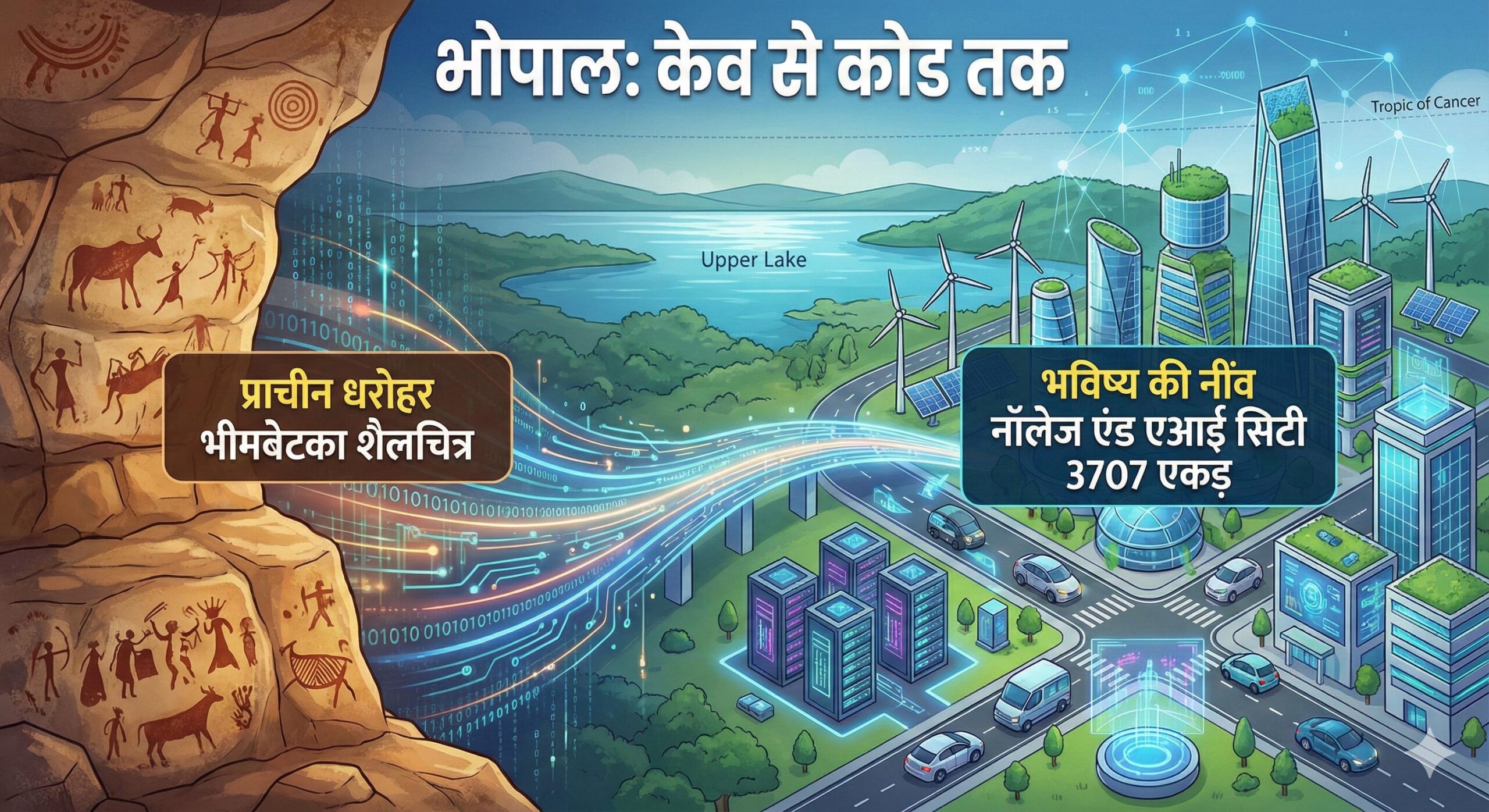
The ‘Kamaal Ka Bhopal’ citizen campaign is a living proof of this. Bhopal is perhaps the only city in the world traversing the journey from ‘Cave to Code’:
• Cave: We house the 30,000-year-old rock art of Bhimbetka, a testament to early human civilization.
• Code: We are laying the foundation for a ‘Next Generation Knowledge & AI City’ spanning 3,707 acres in Bhauri. Furthermore, the repurposing of vacant land in the BHEL township for smart industries is currently under process.
The ‘Kamaal Ka Bhopal’ report submitted to the government is not merely research; it is the runway for the city’s future.
The Logistics Heart and Green Capital
Situated on the Tropic of Cancer, Bhopal is the true ‘Heart’ of India. According to a Google Earth-based study by CREDAI, Bhopal’s 500 km radius constitutes India’s largest landlocked urban zone. From here, over 50% of the country’s urban footprint is accessible within 10 hours. We possess a location advantage for logistics and supply chains that no coastal city can match.
The capital region boasts two UNESCO World Heritage sites. We hold the legacy of King Bhoj’s water management and town planning, which remains a model for the world in the era of climate change. With a green cover comprising a National Park, a Tiger Reserve, and Ramsar sites, Bhopal stands as the country’s most ‘liveable’ capital.
What Do We Need Now? A Package, Not Pity
Bhopal no longer seeks sympathy. We are not asking for ‘charity’; we are demanding ‘investment’ and ‘partnership.’
The Centre and the State Government must realize that the holistic development of Bhopal is not just about one city; it is about revitalizing India’s heartland. We need a ‘Special Reconstruction Package’ on the lines of Japan or Europe—not for compensation, but for:
1. World-class Infrastructure and Smart Industries.
2. Quantum Labs, AI Factories, Research Centers, and Skill Development.
3. Restoring health and human productivity.
4. Recovering the ‘lost time’ we spent in courtrooms.
The message for global Tech Leaders, Investors, and Policy Makers is clear: You witnessed the rise of Bengaluru; you saw the pace of Gurugram and Hyderabad. Now, come build the future in India’s most beautiful, serene, and strategically located city.
Bhopal’s previous page may have been stained by tragedy, but its next page is being written with the brilliance of ‘Silicon’ and the promise of a ‘Phenomenal’ future.
The city once known for its sighs will now be known for its capabilities. That is the true lesson of December 3rd, and that is the resolve of the ‘Kamaal Ka Bhopal’ campaign.
(Author is the Founder of the ‘Kamaal Ka Bhopal’ campaign and President, CREDAI)